


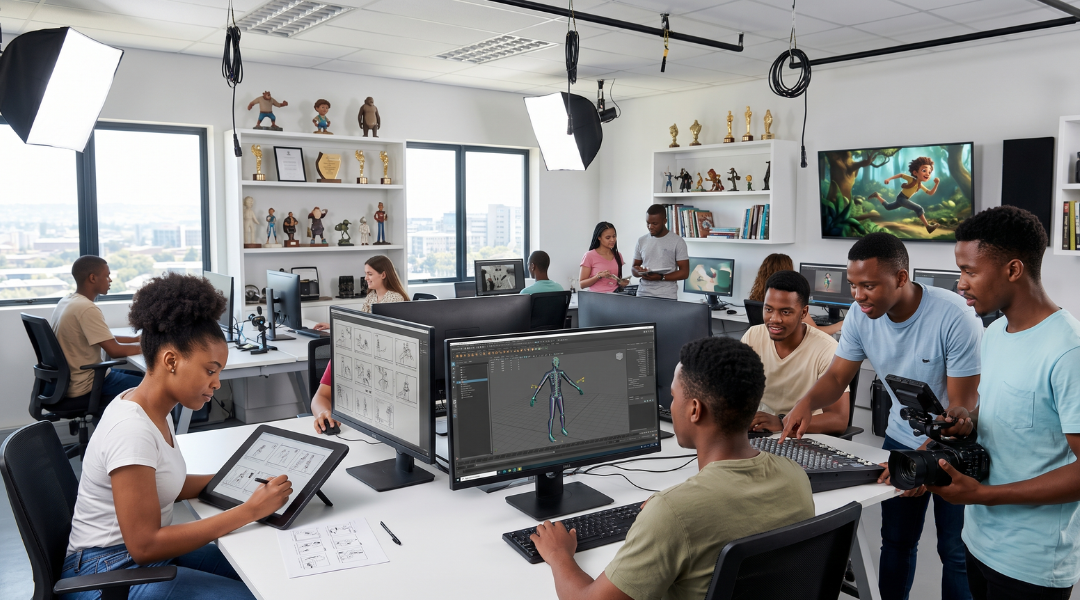
Choosing the right animation school in 2026 is less about prestige logos and more about which program actually puts a working studio pipeline in your hands. With streaming platforms commissioning more original content, gaming studios scaling out their art departments, and advertising leaning harder on 3D motion, demand for trained animators has shifted from "nice to have" to genuinely competitive. We've put this guide together to help you cut through the noise, especially if you're weighing options between local animation schools in South Africa, international institutions, or hybrid online tracks.
Below, we'll walk through what to look for, how to compare tuition, what specialisations actually lead to jobs, and how to build a portfolio that gets past the first reviewer. Whether you're a matriculant in Gauteng or a career-changer in your thirties, this should give you a clearer map.
Why Attending an Animation School Still Matters in 2026
There's a fair argument that YouTube tutorials and AI tools have flattened the learning curve. They have, partly. But what they haven't replaced is structured critique, deadline pressure, and access to working professionals who can tell you why your rig is breaking before you waste three weeks on it.
Good animation schools mirror the actual production pipeline used in commercial studios. That means you move from pre-production (concept art, storyboarding, animatics) into production (modelling, rigging, texturing, animation) and then into post (lighting, VFX compositing, render management). Self-taught artists often jump straight to the fun parts and skip the foundational stages hiring managers test for. This pipeline-first structure is exactly how Oakfields College builds its 3D animation program, so students learn the workflow in the same order a studio would expect them to know it.
There's also the network effect. Sitting next to filmmaking, sound, and drama students means your final showreel can include directed scenes with proper audio mixes, not isolated turntables. That collaborative density is hard to replicate alone.
Types of Animation Courses and Specialisations to Consider
Animation isn't a single discipline. Before enrolling, it helps to know which lane you actually want to drive in, because the software stack, the day-to-day work, and the career exits differ sharply.
2D, 3D, Stop-Motion, and Motion Graphics Tracks
2D animation still drives a large share of broadcast cartoons, explainer content, and indie games. Toon Boom Harmony and Adobe Animate dominate here, with a growing crossover into Procreate Dreams for frame-by-frame work.
3D animation is the bigger commercial bucket. Most studio hiring gates require working knowledge of Autodesk Maya, with Substance 3D Painter for texturing and ZBrush for sculpting. Blender, the open-source alternative, has become a credible entry path for indie developers and smaller studios. This 3D pipeline is the core of what Oakfields College trains for, which is worth noting if 3D is the lane you're leaning toward, since it's also the lane with the most junior openings.
Stop-motion is niche but loyal, with strong pockets in advertising and feature work. Dragonframe is the standard capture tool.
Motion graphics sit between design and animation. Adobe After Effects and Cinema 4D handle most broadcast and brand work, and this track tends to find paying clients fastest.
.png)
What to Look for in the Best Schools for Animation
Picking from a list of schools for animation is easier when you have a checklist that goes beyond glossy marketing reels.
Accreditation, Faculty, and Industry Connections
In South Africa, the first filter is DHET registration (Department of Higher Education and Training) and alignment to the NQF (National Qualifications Framework) with a valid SAQA ID. This matters for parental reassurance, future credit transfers, and student-loan eligibility. Oakfields College clears this bar with DHET-registered qualifications, which is the baseline reassurance any parent or student should insist on before paying a cent. Internationally, look for institutional accreditation recognised by the relevant national body.
Faculty matters more than ranking. Are the lecturers currently shipping commercial work, or did they last touch a render farm in 2014? Ask for recent credits. Active industry professionals bring real briefs, real feedback loops, and references when you start applying for junior roles.
Finally, check the industry pipeline: guest masterclasses, internship partnerships with local studios, and an alumni network that actually picks up calls. A school's last three showreels will tell you more than its brochure.
Top Animation School in South Africa
A handful of international programs are regularly named in industry shortlists, but for South African students, international tuition plus living costs can easily push past R600,000 a year, which is why local options matter.
Oakfields College runs a full-time 3D animation program in Gauteng built around a studio-pipeline model, with cross-departmental collaboration across filmmaking, sound engineering, and drama. This pipeline-first approach means your final showreel is assembled the way real studio work is: animation composited with footage shot by filmmaking students and scored by sound engineering students, giving you a junior credit reel rather than a stack of isolated school exercises.
A few things set Oakfields apart for the South African student specifically. The qualifications are DHET-registered, so they hold weight with employers and qualify for student-loan pathways. The faculty work in the industry rather than teaching from a decade-old textbook, which means the briefs you tackle reflect what studios actually commission. And the cross-departmental campus means you graduate having already collaborated the way you'll be expected to on day one of a junior role, instead of learning that skill cold on the job.
Crucially, it delivers this at a fraction of the international cost and without the visa hurdles of studying abroad, opening a route into feature animation, games, or commercial production that's both credible and achievable from home.
Online vs. On-Campus: Choosing the Right Course in Animation
A campus-based course in animation gives you things online programs structurally can't: spontaneous studio chats, render-farm access, physical critique sessions, and that inter-departmental ecosystem we mentioned earlier. When your animation gets composited with live-action shot by filmmaking students and scored by sound engineering students, your showreel suddenly looks like a junior credit reel, not a school project. This is precisely the kind of environment a campus like Oakfields is built to provide, and it's the single biggest reason on-campus still beats going it alone online.
Hybrid models are also worth considering. Some students start with a 1-year certificate on campus, then layer online specialisations on top during their first junior role. The honest answer is: if you're a self-starter with discipline, online works. If you need accountability and collaborators, campus wins.
Tuition Costs, Scholarships, and Financial Aid Options
Tuition for full-time animation courses in South Africa typically ranges from around R55,000 to R95,000 per year, depending on the institution, software licenses included, and whether the qualification is a certificate, diploma, or degree. International programs sit considerably higher, often R350,000 to R700,000 annually before living costs.
Financial aid options worth exploring:
- NSFAS funding for qualifying public-institution students
- Private student loans through Fundi, Standard Bank, or Capitec
- Modular payment plans offered by private colleges like Oakfields, splitting tuition across the academic year
- Bursaries from production houses, broadcasters, and industry bodies like Animation SA
- Sibling and early-payment discounts at private colleges
A practical tip: shorter 1-year certificate tracks let you test the field at lower financial risk. If it clicks, you scale into the advanced diploma. If it doesn't, you've lost a year rather than three and can pivot into adjacent fields like motion graphics or game art. It's worth asking Oakfields directly which payment and entry options apply to your situation, since the right structure often makes the difference between starting this year and waiting another one.
Career Paths and Salary Expectations After Graduation
Animation graduates don't only end up at feature studios. The realistic job market is broader and, frankly, healthier.
Typical entry roles include junior 3D animator, junior modeller, texture artist, rigger, motion graphics designer, VFX compositor, storyboard artist, and previs artist. Adjacent paths include game art, AR/VR content, architectural visualisation, and medical or technical animation. A pipeline-based program like the one at Oakfields exposes you to several of these roles before you graduate, which helps you target the one that actually fits you rather than taking the first thing offered.
South African salary benchmarks (PayScale and local recruiter data, 2025):
- Junior 3D animator: R180,000-R260,000 per year
- Mid-level animator: R300,000-R480,000
- Senior animator/lead: R500,000-R900,000+
- Motion graphics designer (mid): R280,000-R420,000
Internationally, juniors at studios in Vancouver, London, or Montreal often start between USD 50,000 and USD 70,000. Remote freelance work for international clients is increasingly common, which lets local animators bill in stronger currencies while staying based in South Africa.
.png)
How to Build a Standout Application Portfolio
Here's a quiet truth a lot of prospective students worry about: you don't need to be a fine-art prodigy to get accepted. 3D modelling, hard-surface texturing, and rigging rely far more on spatial reasoning and programmatic thinking than on hand-drawn sketching. If you can read geometry and follow logical node systems, you can train into the craft.
For your application portfolio, focus on:
- 3-5 strong pieces, not 20 mediocre ones
- Process shots: wireframes, blockouts, breakdowns, reference boards
- One short animated piece showing timing and weight, even if it's a simple bouncing ball or walk cycle
- A clear written statement about why you want to animate and what stories you want to tell
- Clean presentation: one PDF or one portfolio site, no scattered Google Drive links
Reviewers want to see how you think, not just what you can copy. Show iteration, show feedback you've acted on, and show one piece you finished even when you didn't want to. That last one is the real signal. If you're unsure whether your portfolio is ready, Oakfields runs open days and Student for a Day sessions where you can get that read directly from people who assess applications.
Final Thoughts
Picking among animation schools comes down to fit, not rankings. The right program matches your budget, your career target, and the way you actually learn. For South African students, Oakfields College checks the boxes that matter most: a studio-pipeline curriculum that mirrors real production, DHET-registered qualifications that hold weight with employers and lenders, active industry faculty, and a collaborative campus where your showreel benefits from filmmaking, sound, and drama partners — all at a fraction of the international price tag.
Start with honest self-assessment, attend an Oakfields open day or a Student for a Day session, talk to recent graduates, and ask hard questions about hiring outcomes. Animation is a long career, and the school you pick in 2026 should give you the technical foundation, the network, and the portfolio to make the first five years count. When you're ready, the Oakfields applications page is the place to start.
Frequently Asked Questions About Animation Schools
Why should I attend an animation school instead of learning through online tutorials?
Animation schools provide structured critique, deadline pressure, and access to working professionals who guide your work in real time. They mirror commercial studio pipelines and offer collaborative environments where your projects benefit from sound, filmmaking, and drama students-creating portfolio pieces that look like professional work. Campus programs like Oakfields College are built specifically around this kind of cross-departmental, pipeline-based learning.
What are the main animation specialisations I should consider?
The primary specialisations are 2D animation (Toon Boom Harmony, Adobe Animate), 3D animation (Autodesk Maya, Blender), stop-motion (Dragonframe), and motion graphics (After Effects, Cinema 4D). Each has different software requirements, daily workflows, and career paths, so choose based on your interests and market demand. If 3D is your target, Oakfields College runs a full-time 3D program built around studio software and workflow.
How much does animation school cost in South Africa?
Full-time animation courses in South Africa typically range from R55,000 to R95,000 per year for certificates, diplomas, or degrees. Shorter 1-year certificate tracks offer a lower financial entry point to test if the field suits you before committing to longer programs. Private colleges like Oakfields also offer modular payment plans that spread tuition across the academic year.
What is the average salary for entry-level animators?
In South Africa, junior 3D animators earn R180,000-R260,000 annually, while motion graphics designers at mid-level earn R280,000-R420,000. Internationally, juniors at studios in Vancouver or London start between USD 50,000-USD 70,000, with remote freelance work offering opportunities to bill in stronger currencies.
Is online animation training as good as attending campus-based schools?
Online programs excel for specialisation but lack spontaneous studio collaboration, render-farm access, and inter-departmental projects. Campus-based animation schools like Oakfields College offer accountability and real-world pipeline experience. Hybrid models combining 1-year certificates with online specialisations are increasingly popular.
What should I include in an animation school application portfolio?
Focus on 3-5 strong pieces showing your thinking process: wireframes, blockouts, and breakdowns. Include one short animated sequence demonstrating timing and weight, process shots, and a written statement about your goals. Reviewers prioritise iteration and finished work over quantity, valuing candidates who show how feedback shapes their improvements. Oakfields College open days are a good place to get an early read on whether your portfolio is on track.


.png)